


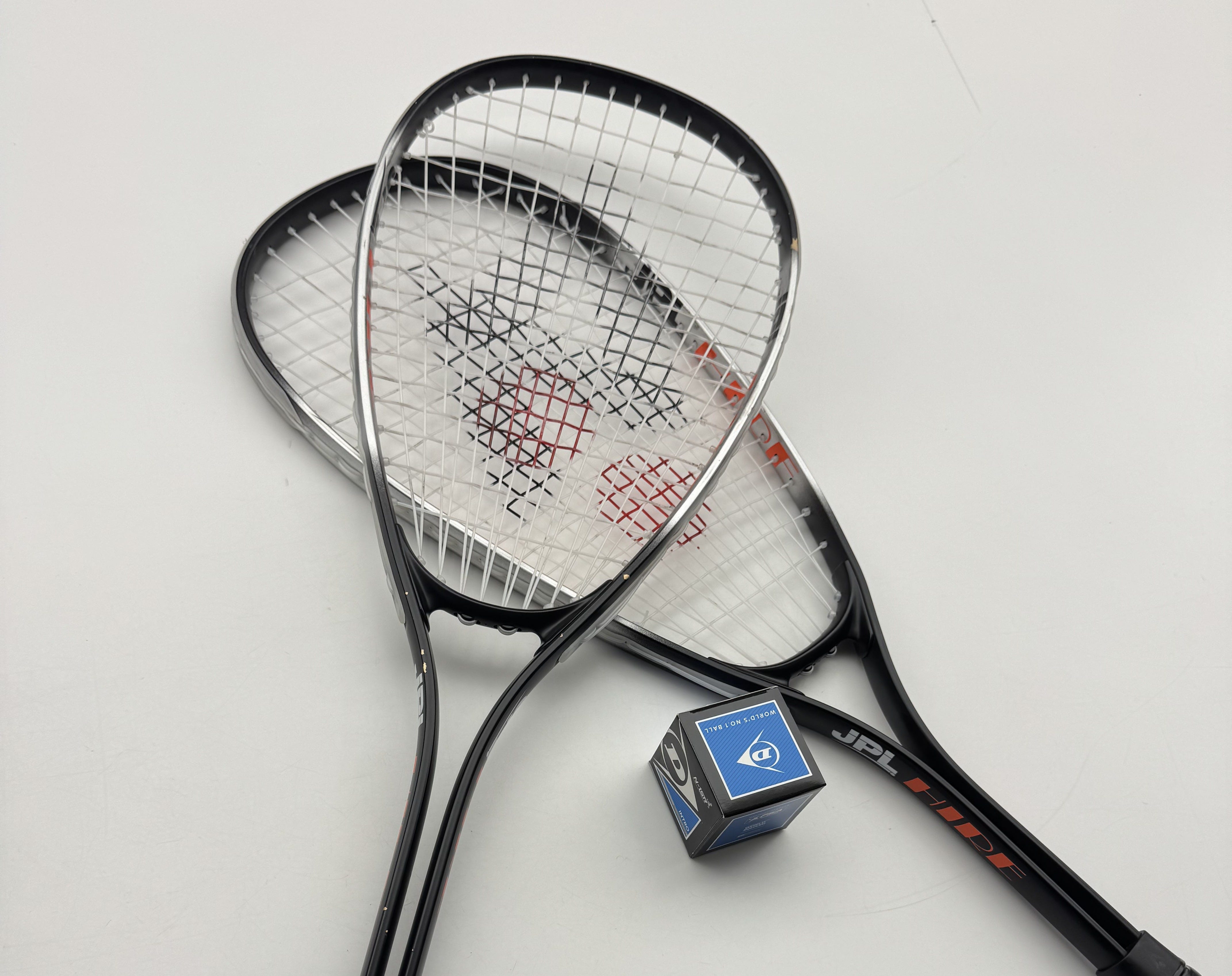
It’s the dark yet mild morning of Monday 8th December. The week immediately following George’s 29th birthday and the week commencing my 27th. I found a slightly awkward slot under my arm for the rented rackets and waited for George to dismount from his Lime Bike before a welcome hug. Of course.
We both yawn as we navigate the behemoth turnstile doors of Britannia Leisure Centre, Hoxton.
Breaching the front desk, we’re offered 3 different ball types: Pro, Intermediate or Beginner.. The perplexed look on our faces immediately encouraged the staff member to begin raising her hand towards the beginner. Probably wise.
Chosen activity: Squash
Court price: £9
Ball Price: £3.99 (to keep) (beginners)
Guest pass for George: £3
Racket Rental: £4
Total: £19.99
Heading up the first floor to court 1, George marches into the lift like he’s been here a hundred times as he presses the button.
As I set up my kit, we bond over the quality of Lulu Lemon shorts we both happen to be wearing and my recent discovery of the pocket lining for phones. A fantastic short, no two ways about it.
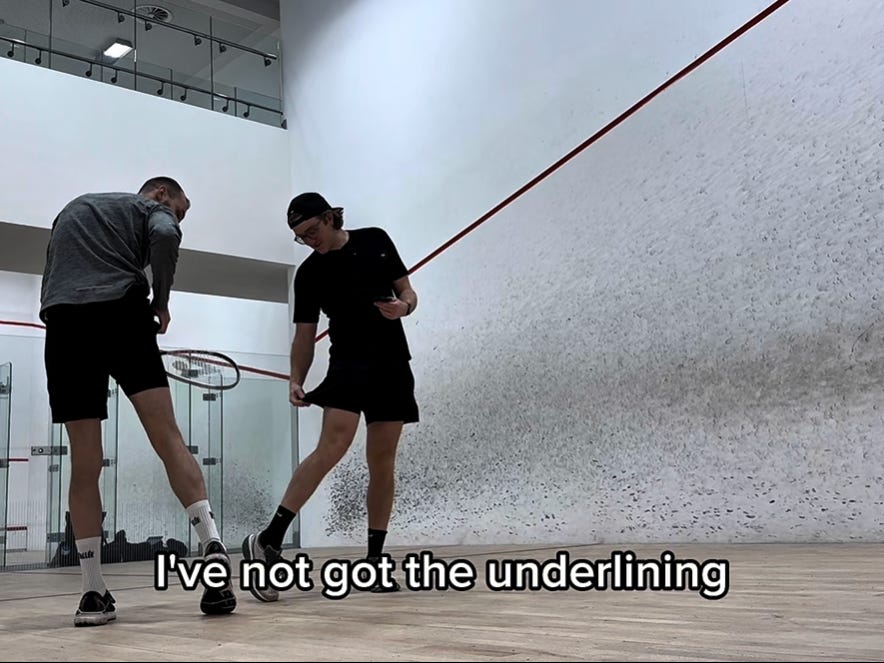
“Have you played squash before?” George asks as he hits a few shots against the wall and I have a battle with the gimbal in the front right of the court.
“I’ve only ever hit around with an old housemate who played at county level, he just stood in the centre and I ran foolishly around him” … I start to realise George’s quietly confident energy as I witness his natural racket flick technique for the first time.
First, some ice breakers:
Q: Are you naturally competitive, George?
G: Yes, definitely
**What struck me here wasn’t the answer, but how quickly it arrived. Shook**
Q: You’re bringing a pudding to a party - what are you bringing?
G: Sticky toffee pudding, and it’s homemade, Mary Berry BBC Good Food recipe every time.
Q: What’s your favourite season of the year?
G: Spring, gives you hope you know, that winter’s over, you’re getting back to some nice days.
W: Not 7:00am on a squash court, then.
G: No, 7:30. 7:30 is fine.
Q: Rank these things: diet, sleep and exercise.
G: Exercise, diet and sleep.
But I think sleep probably should be No. 1 — but I just don’t get enough of it. I think everyone will say that.
Q: When was the last time you danced?
G: Probably a few weeks ago when I was in Japan doing karaoke for the first time, and I was having a boogie then.But then I danced quite often, maybe yesterday.
Q: George Wade is on a playground at primary school - set the scene: What’s he thinking, seeing and feeling?
G: I’m thinking about football, I’m probably seeing football. But actually this is my one claim to fame. When I was in Year 4 maybe, I used to play cricket. Blue bats. Orange ball, like the blue bats, you know the one, the blue bats. Josh Inglis, who played for Australia in cricket, actually used to go to my school in Leeds. I remember I used to play football with his brother. I distinctly remember one day I hit my first ever six, and it was Josh Inglis bowling spin. And I was like, and I was like, “oh that’s unimportant in life”And then now, I’m so glad that memory stuck because I can say I’ve hit him over the school gate.
You watch, when I’m playing squash just now, and I’m gonna be like:
*George mimics a perfect underarm swing with his racket*
Q (W): Right, you can only drink three things for the rest of your life — what are they? We can remove water if you’d like.
G: Yeah, I think remove water.
W: It’s essential, most people tend to need that, yeah.
G: I would probably go coffee, of the filter kind, like a good pour-over filter. I would go for… uh, a pint specifically, of Guinness, which is so basic. And then third say cup of tea. Oh no, I like a good squash, like an orange squash.
W: Robinsons?
G: Well, insert any named brand here - cordial, yeah. Cordial.
In a picnic about how much phone storage I’ve got, I feel it’s time to get stuck into some gameplay.
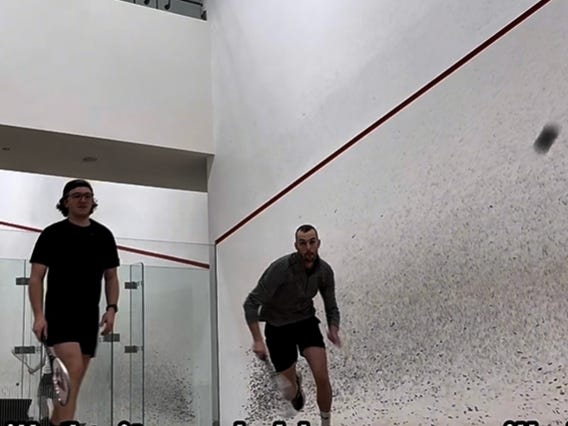
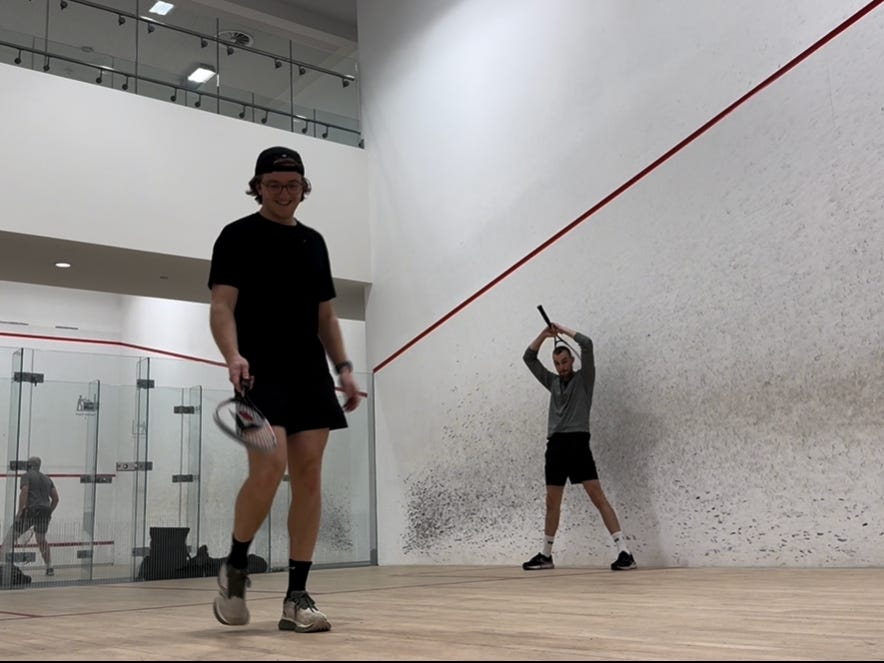
We play the first game, he’s got the basics down, uses his power well and is surprisingly nimble across the court as we both try and remind ourselves of the rules, with mixed clarity I might add.
Immediate observations of Squash:
The ball heats up, a lot
The wall, every wall, comes up fast
Obstructions are common and if you preface any point of objection politely with “I think”, you can get away with murder. And boy I needed to murder.
Longest rally - 25 seconds, yet a narrow 1st game loss for me: 13 - 11 to George.
Back to it.
Explain what Zevero does like you would to a child and then a PhD student.
To a child I would say: we make the planet better with numbers. Or we try to at least… there’s no way you can explain anything else!
In terms of what actually we do, we quantify the numbers behind people’s business decisions when it comes to carbon reporting, so you have your impact as a business so you’re very easily able to measure it on a balance sheet.
We effectively do the same for planetary impact, so every squash ball that you buy, every racket you produce, every flight you take, our job is to quantify the metrics behind it and then use that data to either help you make changes, or for you to use that data to make changes effectively.
How hands-on are you with the discoveries you make for each business?
We definitely have some clients that just want the data and then they’ll use their own team to work on the insights and aim for decarbonization.
But then we work with some really cool projects and they don’t always know what they need or what to do. So our job is often to help them take the data and go “ok great now what does it mean and what do we do?”
Which is good and especially in mid-market companies where there’s maybe one sustainability manager, where we actually act as an outsourced sustainability team effectively.
What’s the largest, presumably smallest would be one person, team that you’ve dealt with within the core sustainability function of an organisation?
Zero for sustainability, as often it’s chucked on like an operations role or supply chain role.
**George gestures to me with his racket as I have done exactly that in the past.
However we work with some organisations in Japan, for example, with the Tokyo Government, which have got a couple of hundred people that work on climate. It normally ranges from zero to half a person’s role, to maybe a 10-person team.
Do you find, money aside, as in funding to fuel sustainability functions, you find that the smaller the team… the easier it is to input changes?
I think it doesn’t matter whether it’s a big team or a small team. It’s about the buy-in of the organization.
So for example, you could have a one person team and that’s someone that in 2021 has gone “I wanna do this give me four grand a year” yet now they’re kind of stuck because it’s not really full company buy in so they’ve not seen much progress. Whereas, if you have big organisations and they mobilize good project management, then that makes it much easier. It really depends on the company’s attitude to making changes.
WO: Okay okay. Let me check if this is filming. I’m getting concerned.
Tell me something you’re less good at than your co-founder Ben.
Anything to do with numbers. Yeah we always used to say to clients, “I deal with the words, Ben does the numbers to the point where clients want. Customers used to come to us and say, “I’ve got a question revolving around words and numbers. Who do I go to?” And we’re like, “either of us can fix it. We’ll just work together.” But I’m so bad when it comes to the details of the numbers side of things. Stories and building narratives I can do.
What do most people misunderstand about carbon accounting?
It’s both easy and really hard. Some people think they don’t really understand anything about it. But you can do it really simply and you can do it in a way that makes it easier at the beginning.
Even the big organisations are still improving their data and granularity. So it’s like the biggest pet peeve of when we speak to customers. I spend a lot of time convincing them or educating them around actually no, we just need some data to make better decisions and then go from there.
The biggest misconception is that you have to be perfect from day one, people would think, “Oh my gosh, you’re going to do it perfectly every time. Financial data you can’t get away with being not perfect, whereas in carbon accounting data, actually, it’s just about how you use the information to give you the best understanding of where you should focus.
Game 2:
12 - 10 to George.
Although morally I felt I won this one and it’s important to me to have that on record. It’s a warm court and George rather coolly corrects the running cap he’s got on and enquires about more questions.
Ask and you shall receive.
If you had to email yourself from the past, you can’t go into detail, but you have one subject line be?
Don’t give up. We spent so long slogging it out and then all of a sudden it felt like we’ve done really well. Like it just takes so much hard work building, with very little movement and there’s not a lot of light at the end of the tunnel always.
Yeah, if I didn’t just work hard for three and a half years and do nothing but concentrate on Zevero, then I wouldn’t be where I am now so it’s good to back yourself to do stuff that’s hard, and just don’t give up.
Do you think past George would have seen that subject line and gone, “bloody hell future George, give me more than that!”
Probably yeah, or maybe something like “it’ll all be alright in the end”, but I think that’s probably the biggest thing for me is how i’ve been able to stick to a task pretty well. It’s served me well that’s for sure.
What still excites you about Zevero today, that also did on day 1?
It’s equally exciting and scary because I’d say it’s actually why we do what we do, like helping companies tackle the climate crisis, which is still exciting but also the fact that we can do something about it. But it’s equally scary because we’ve not really made too much progress as a society, yet it’s been a long time.
Has it gotten any easier? With climate information, what people’s perceptions are, or even the scale of Zevero?
To be honest, it’s kind of stayed the same I think. There was almost a period in 2020 where society was like “we can do everything for the future”, like it’s a reflection point, and then more right-wing politics came back in progress and we’ve kind of regressed to the point where people still think it’s not even real. So I think we’ve made progress in some ways but then we’ve also gone back from this.
I think from a corporate side of things there’s more people making real differences now. We’re seeing, like actually from a financial perspective, it often makes more sense to go green. But at the same time, there isn’t a real like yeah it’s still very difficult for a company to really commit to that and make a change.
Do you think that when you mention it, it makes more financial sense to companies? Do you think that’s because it can be twisted as a sort of greenwashing plot to push sales, or do you think it’s more because there are benefits of doing it regardless?
We work with Jubel, which are now fully regen barley, which is pretty incredible because the big brewers and even the craft brewers aren’t doing that. As a result, they’re getting more space in Waitrose and they’re getting more of the feature for free.
So there’s a lot of intangible benefits now with case studies whereas before it was like “but if we do that we don’t know what’s going to happen”, now there’s more examples of “if we do that, this is the exact ROI and here are all the other external benefits as well”.
So the first “green” movers got all of the benefit from a top-line perspective because consumers went towards brands that were appearing to do good, but now for the first time it feels more like the bottom line may also benefit. Would you agree?
I also think that there are definitely categories where consumers have realised who actually gives a shit. So if companies do care and it’s done right, there’s still a top-line benefit but it’s really difficult.
Patagonia’s impact report came out and said “we’re really bad for the planet” and the problem is every time they sell another item of clothing, they make more of an impact, so that is counterproductive.
Sometimes what you produce is really good in terms of ethos but at the same time you want to reduce your impact. Yet every time you put out great ethos, consumers go “yeah I want to buy from Patagonia because they’re caring so much, meaning their emissions go up because they have to sell more because of increased demand.
So there’s a really tricky balance between what we merit as a society around that long-lasting clothes.
You’ve recently been acquired and you’re still on board, how do you think an exit has changed as a person?
I think it’s given me a little bit more obvious financial security to be able to work hard but not worry about moving back home and living with my parents. It’s removed the case of borrowing money for rent from my grandad every three months and all that sort of stuff. But I think it’s also given me access to a lot of things that I have benefited from, things like therapy and spending more money on exercise and good food.
So I think it’s changed me in the sense of it’s made me be able to do more with my life and it’s kind of removed that burden of the stress of “what happens if the business fails? Do I have to start again with my parents?”
Would you say that your family but more specifically your parents are very much in the loop with the progress and what you do day to day, or would you say it kind of came as a surprise when you said “an amazing company has decided to acquire us?”
It was very much a surprise for me, so when I told them it was equally surprising for them, they were like “bloody hell, that’s amazing!” *Strong Leeds Accent.
But the thing is I’ve always had support from them. My mom was always like “I knew it’d happen for you”, which is really nice because I just know I’ve got that support behind me.
W: There’s nothing quite like your mother’s unrelentless backing of you. “Yeah you’ll do it”, “I know you’ll do it”.
I always find it fascinating how, with young startups, you get close with your colleagues immensely quickly because you see them in such an array of emotions. So then, when you bring your family into it, it’s kind of a strange clashing of worlds. Have they met your co-founder, Ben, and how’s that as a dynamic?
I think they might have only met once or twice but it’s funny because Ben and I spend a lot of time together at work so we don’t spend a lot of time together outside of work.
We have our separate parts but the only time where we spend really a good amount of time together when it’s not work, is when we’re away for business trips over a weekend and we just go and explore and have lunch.
Ben is my co-founder but his cousin is actually my best mate, so I’ve been at my mate’s house with Ben’s parents there because there was a family thing, and I’m there at the same time, so i’ve met his parents more. I think also because my parents live in Wales as opposed to London, it’s not as easy.
For the business, what would have been the least entertaining to be interviewed, period. Versus the most exciting time?
The most exciting time to be honest would probably be now or maybe like the beginning when I was like all hopes and dreams and had no idea what I was doing, it was probably absolutely bs.
The worst was probably 2022, we basically moved office from a four-person place to a little two-person office because we couldn’t afford the WeWork rent, but we needed somewhere. It was a glass container for two people, so Ben and I worked in the communal area and it was basically nine months of them telling us off for sharing passes amongst our team.
Ben and I were like “this is so hard, like what are we doing, why why are we getting paid 16 grand a year yet working our asses off and not seeing the end of it”, that was probably the most difficult
Whereas I feel now is a good time, we get to do lots of cool stuff and we know what we’re doing more now. As opposed to even last year when we were acquired, I’ve never been so stressed and depressed in my life because I was overwhelmed. You go from a 4-5 person team to 40 of you and you’re running global operations and I hated it in the sense that I just don’t know what I’m doing, I don’t know how to improve and I’m just constantly bombarded with stuff.
So that wouldn’t have made for good interviewing because I’d have probably just canceled on you a few times.
The final game.
After a very strong start to my second Squash outing, and as a proud new member of the Britannia Leisure Centre, you’ll be pleased to know I’m winning.
…
Up until 6 points, where I lose the plot and allowed George to close out the game with the professionalism of Novak Djokovic.
What do they say, always let your guests win?
On reflection, George was calm from start to finish, asked genuine questions and was a tidy Squash player. To my frustration.
Having founded, scaled and sold a business that truly does good for it’s customers and the planet, I’m pleased to observe he seems his happiest and most excited about Zevero right now.
It also helps that George was the only mutual friend of both my girlfriend and I when we met. He’s served as a real ally to us both and he’s a wonderful all-round human being.
Thanks George.
Until next time,
Will.